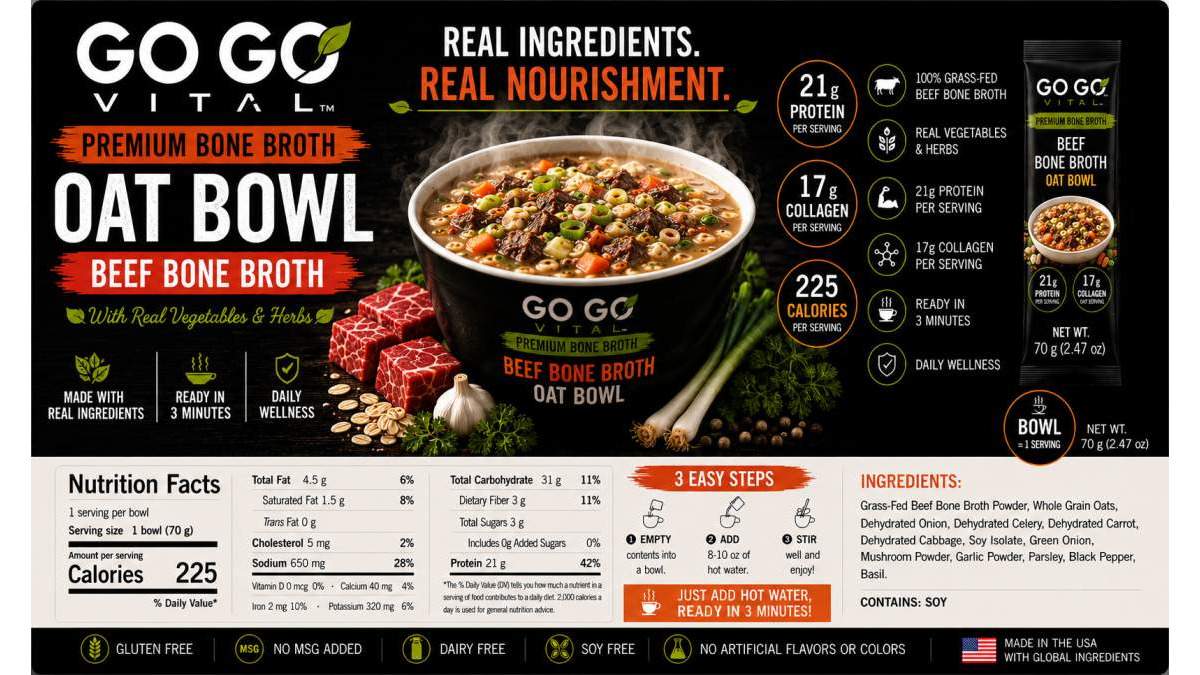
Best Fresh Bone Broth Delivery Service: 2026 Guide
Table of Contents
- How Fresh Bone Broth Delivery Works
- Benefits of Daily Bone Broth Consumption
- Frozen vs Shelf-Stable Bone Broth
- How to Choose High-Quality Bone Broth
- What the Best Fresh Bone Broth Delivery Service Costs Per Ounce
- Subscription vs One-Time Orders: Which Saves More
- Shipping, Packaging, and Storage After Delivery
- Conclusion
- Frequently Asked Questions
Last Updated: September 13, 2026
How Fresh Bone Broth Delivery Works
Fresh bone broth delivery ships refrigerated or frozen broth, simmered in small batches and packed to arrive cold, to your door on a recurring or one-time schedule. At GO GO VITAL, each order is prepared fresh and packed to protect quality and freshness in transit.
You choose a delivery frequency, the broth is batch-cooked close to your ship date, and it arrives in insulated packaging with cold packs, ready for your fridge or freezer.
What separates a good service from a mediocre one comes down to three things: how close to shipping the broth is made, how the cold chain holds up in transit, and how transparent the provider is about sourcing and ingredients.
Below: the benefits, the frozen-versus-shelf-stable trade-off, how to judge quality, and what you're really paying per ounce.
Benefits of Daily Bone Broth Consumption
Daily bone broth consumption supports hydration, protein intake, and a consistent wellness routine, especially for people who struggle to cook from scratch. The practical benefit is habit: a warm, nutrient-dense cup is easier to repeat than a complicated meal.
The nutritional case rests on a few pillars:
- Collagen and gelatin from slow-simmered connective tissue
- Amino acids including glycine and proline
- Protein that's easy to sip rather than chew
- Whole-food ingredients rather than engineered supplements
Many people find broth fits a gut-friendly, anti-inflammatory eating pattern, and it's a convenient way to hit protein targets on busy days.
The catch most guides skip: benefits depend on consistency. A daily cup, built into your morning or afternoon, is where the routine pays off.
Frozen vs Shelf-Stable Bone Broth
Frozen bone broth is simmered fresh, frozen shortly after cooking, and shipped cold, preserving flavor and texture. Shelf-stable broth is heat-processed to sit at room temperature for months. The trade-off is convenience versus freshness.
Here's how the two compare:
| Factor | Frozen Fresh | Shelf-Stable |
|---|---|---|
| Processing | Slow-simmered, frozen | High-heat sterilized |
| Texture | Gelatinous when chilled | Thin, rarely gels |
| Flavor | Closer to homemade | Often flatter |
| Storage | Freezer required | Pantry |
| Shelf life | Months frozen | A year or more |
| Shipping | Cold chain needed | Standard |
That gelatinous texture is a useful signal: when a broth gels in the fridge, it points to higher collagen and gelatin content from real connective tissue. Shelf-stable cartons rarely gel because processing breaks down those proteins.
If you travel constantly, shelf-stable wins. If you want the closest thing to a pot simmered on your own stove, frozen fresh is the better call.
How to Choose High-Quality Bone Broth
Choosing high-quality bone broth comes down to sourcing, ingredients, and how it's made. Read the label before the marketing.
Look for these markers:
- Grass-fed or pasture-raised bones, ideally from regenerative agriculture
- Organic ingredients and a clean label with no preservatives
- Slow-simmered for a long window, not rushed
- A high bone-to-water ratio for richer collagen content
- Traceability so you know where the bones came from
Sodium matters too: some broths lean heavily on salt, so compare milligrams per serving if you're watching intake.
Protein content is the other number worth checking. A broth with meaningful protein per cup is doing more work than one that's mostly water and seasoning. The USDA FoodData Central database is a useful reference for comparing the nutritional profile of broth and stock.
A common mistake is buying on branding alone. A pretty label says nothing about sourcing standards or simmer time; the ingredient list and nutrition panel tell the real story.
What the Best Fresh Bone Broth Delivery Service Costs Per Ounce
Cost per ounce is the only fair way to compare fresh bone broth delivery services, because package sizes, protein density, and shipping terms vary so widely that sticker prices are close to meaningless. This section does the math.
The three numbers that actually determine value
Every fresh bone broth order can be reduced to three figures:
- Cost per fluid ounce, total order price divided by total ounces shipped.
- Cost per gram of protein, total order price divided by total grams of protein in the order. This is the number that exposes broths that are mostly water and salt.
- Delivered cost per ounce, cost per ounce plus shipping, divided across the order. A cheap base price with a $25 cold-chain shipping fee is not cheap.
A broth that costs more per ounce but delivers twice the protein per cup is often the better buy.
A worked example
Suppose a fresh delivery service sells a 24-ounce container for $12 and lists 10 grams of protein per cup (8 fluid ounces). That is:
- $12 ÷ 24 oz = $0.50 per fluid ounce
- 24 oz ÷ 8 oz per cup = 3 cups
- 3 cups × 10 g protein = 30 g protein in the container
- $12 ÷ 30 g = $0.40 per gram of protein
Now compare a shelf-stable carton at 32 ounces for $8 with 6 grams of protein per cup:
- $8 ÷ 32 oz = $0.25 per fluid ounce
- 32 oz ÷ 8 oz per cup = 4 cups
- 4 cups × 6 g protein = 24 g protein
- $8 ÷ 24 g = $0.33 per gram of protein
The shelf-stable carton looks cheaper per ounce but is only marginally cheaper per gram of protein, and it rarely gels. Add cold-chain shipping to the fresh order and the gap can narrow or flip entirely, which is why the per-gram figure matters more.
What typically drives the price up or down
- Bone source. Grass-fed, pasture-raised, and regenerative-certified bones cost more than commodity bones.
- Bone-to-water ratio. A richer ratio means more collagen and protein per ounce, raising cost but also per-gram value.
- Simmer time. Long, slow simmers consume energy and facility time; short simmers are cheaper and thinner in the cup.
- Packaging format. Frozen containers require insulated liners and cold packs; shelf-stable cartons do not.
- Order size and frequency. Larger orders and subscriptions spread shipping across more ounces, lowering delivered cost per ounce.
A comparison framework you can reuse
| Step | What to Do |
|---|---|
| 1 | Divide total order price by total fluid ounces |
| 2 | Divide total order price by total grams of protein |
| 3 | Add shipping and divide by total ounces for delivered cost |
| 4 | Compare the per-gram figure first, then the delivered per-ounce figure |
| 5 | Re-run the math at the subscription price, not just the one-time price |
For current pricing on fresh, small-batch options, GO GO VITAL lists rates directly on its site, including the per-container ounce count and protein per serving you need to run the math above.
Subscription vs One-Time Orders: Which Saves More
Subscriptions almost always beat one-time orders on delivered cost per ounce, because recurring volume lets a provider plan production, buy bones in larger lots, and ship predictably. The catch is commitment, and the discount size determines whether it's worth it.
Why subscriptions are cheaper, mechanically
Three cost drivers fall when you commit to a recurring schedule:
- Production planning. A provider knows how much to simmer each week, reducing waste and enabling volume bone buying.
- Shipping consolidation. Recurring orders ship on a fixed cadence, spreading cold-chain packaging and carrier costs across predictable revenue.
- Retention pricing. Providers routinely pass part of the retention savings back to subscribers as a discount off the one-time rate.
That is why the same container can cost meaningfully less per ounce on subscription. The discount reflects real cost reductions, not a marketing gimmick.
How to decide in under five minutes
Run this sequence before you commit:
- Calculate your real daily or weekly consumption. Count the cups you actually drink, not the cups you intend to drink.
- Convert that to ounces per month. One cup is 8 fluid ounces; a daily cup is roughly 240 ounces per month.
- Divide by the container size to get containers per month.
- Price that quantity at both the one-time and subscription rates, including shipping.
- Compare the annual difference. If the subscription saves more than the cost of one wasted container per year, it is the better deal.
A common pattern is a 10 to 20 percent subscription discount off the one-time price, plus free or reduced shipping above a minimum order. Check each provider's current terms, since percentages and thresholds change.
When a one-time order is the right call
- You have never tasted the broth. Texture and flavor vary widely, and a subscription you don't enjoy is one you cancel.
- You are testing a new routine. Buy one order, drink it on your real schedule, and see whether the habit holds.
- You travel frequently. If you're away more than a week or two per month, a fixed cadence will outpace your consumption.
When a subscription is the right call
- The habit is already established. You know you will drink it, so the recurring discount is pure savings.
- You have freezer space. Subscriptions work best when you can absorb a delivery without rearranging your kitchen.
- You want price stability. Locking in a recurring rate protects you from one-time price increases.
The business case shifts the math entirely
For gyms, salons, offices, and studios, a subscription is inventory, not a personal cost. A recurring delivery turns broth into a menu item, member perk, or retail add-on, and the per-ounce cost becomes a cost of goods. The question then is whether the margin per cup covers the subscription cost. GO GO VITAL works with businesses to integrate its Bone Broth & Veggie Soup into their spaces, turning a wellness perk into a revenue stream.
Shipping, Packaging, and Storage After Delivery
Fresh broth arrives cold and needs to stay cold. Packaging integrity protects the product between the facility and your kitchen.
When your order lands:
- Check the temperature immediately. It should arrive cold, not cool.
- Refrigerate or freeze right away. Don't leave it on the counter.
- Follow the provider's thawing instructions if frozen. Thaw in the fridge, not at room temperature.
- Use reheating methods that don't boil the broth, which can dull flavor and texture.
Shelf life depends on the provider and whether the product is refrigerated or frozen, so check the label. Once thawed, use it within the provider's recommended window.
The cold chain is the whole game with fresh delivery. If a box arrives warm or the packaging is compromised, contact the provider before consuming it. Freshness only holds if the product stayed cold the entire way.
Conclusion
The hard part isn't finding broth. It's finding a fresh, small-batch option that fits your routine and holds up in transit. Most people default to convenience and end up with a shelf-stable carton that never gels.
GO GO VITAL prepares each order fresh and packs it carefully to protect quality and freshness, so a daily cup becomes the easiest wellness habit you keep. For individuals, it's a consistent routine without the cooking. For gyms, salons, and offices, it's something members and clients will actually use, and a new revenue stream.
Order yours today and build the daily habit that sticks.
Frequently Asked Questions
What company has the best fresh bone broth delivery service?
The right bone broth delivery service depends on how you'll use it. Look for a provider that prepares broth fresh to order, ships nationwide in insulated packaging, and lists sourcing standards like grass-fed or pasture-raised bones. GO GO VITAL prepares each batch fresh and packs it carefully for delivery. Compare cost per ounce, sodium levels, and delivery windows before you commit, since freshness and packaging integrity vary widely between providers.
How should fresh bone broth be stored after delivery?
Move fresh or frozen bone broth into the refrigerator or freezer as soon as your box arrives. Refrigerated broth should be used within the timeframe the provider lists on the label, and frozen broth keeps for months. If your delivery arrives warm or the packaging is damaged, contact the provider before consuming it. Shelf-stable cartons can stay in the pantry until opened, then go in the fridge.
Is there a downside to drinking bone broth every day?
Daily bone broth fits most routines, but watch sodium levels if you're managing blood pressure, since some brands pack significant sodium per cup. Protein content also varies, so it may not replace a full meal on its own. If you have a specific health condition, check with your doctor before making it a daily habit. Otherwise, many people treat it as a warm, nutrient-dense part of their morning or afternoon routine.
How is fresh frozen bone broth different from shelf-stable bone broth?
Frozen bone broth is typically slow-simmered and frozen soon after cooking, which helps preserve its gelatinous texture and flavor. Shelf-stable broth is heat-processed for a longer pantry life, which can change taste and texture. Frozen delivery costs more to ship and needs freezer space, while shelf-stable options are easier to store. Your choice comes down to whether you prioritize freshness or convenience.